why real estate portal leads go cold and how AI can fix slow response times | 9 min read | Ezora Editorial Team
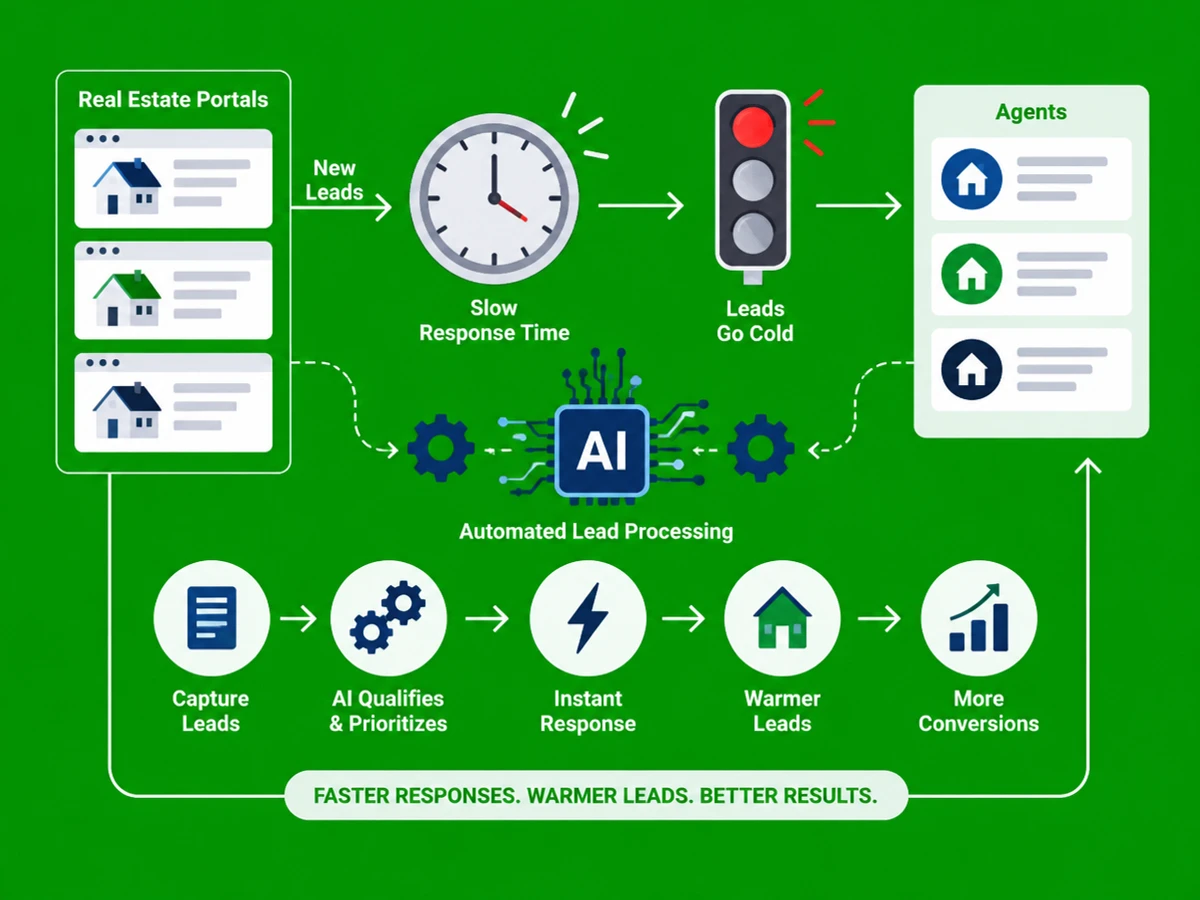
Real estate portal leads from 99acres, MagicBricks, and Housing.com go cold for a simple reason: buyers submit the same enquiry to several brokers at once, and whoever calls back first usually wins. Industry data shows the average real estate agent response time is 917 minutes, roughly 15 hours, while only a small fraction of agencies reply within the five-minute window that actually converts. Most agency workflows still run on manual call lists, shift schedules, and after-hours gaps that an AI voice agent can close in under a minute.
This issue hits Indian agencies hard because portal subscriptions are expensive, and every unanswered enquiry is marketing spend that never turns into revenue. Agencies, insurers, rental managers, and home services businesses all compete for the same impatient customer, and that customer rarely waits.
A listing gets a buyer's attention for thirty seconds. A callback gets their commitment, but only if it arrives before a competitor's does.
Why Do Real Estate Portal Leads Go Cold So Quickly in India?
Portal leads go cold because the same enquiry is often distributed to several brokers simultaneously, and buyers gravitate toward the first person who answers. Portals remain the largest single source of real estate buyer enquiries in India, so the competitive pressure to respond fast is highest exactly where agencies spend the most.
The Shared-Lead Reality
A buyer's form submission often reaches the developer, the channel partner, and a second broker at the same moment. Speed of response is everything, since the first broker to call or WhatsApp the buyer wins the conversation, regardless of who has the better unit or the sharper pitch.
The Manual Follow-Up Bottleneck
Most teams still download leads from portal dashboards, assign them by hand, and rely on whoever happens to be free. 41% of brokerages surveyed did not respond to an inquiry at all, only half responded within 3 days, and just 9% responded within 5 minutes.
- Portal volume outpaces staffing: A well-listed project in Mumbai, Bengaluru, or Delhi NCR can generate hundreds of enquiries a month, far more than a small sales desk can call back promptly.
- Night-time browsing, daytime callbacks: Buyers scroll listings in the evening, while call centers run daytime shifts, leaving a gap exactly when intent is highest.
- No single source of truth: Leads scattered across 99acres, MagicBricks, Housing.com, WhatsApp, and Meta forms rarely land in one queue, so some simply sit unopened.
- First-responder bias: The National Association of Realtors reports 78% of buyers work with the first agent who responds, turning a response-time problem directly into lost revenue.
| Performance Tier | Typical First Response | Lead Conversion Rate | What Separates Them |
|---|---|---|---|
| National average (India) | 4 to 6 hours for portal leads | 1 to 3 percent | Manual lead collection, inconsistent follow-up |
| Structured follow-up agencies | Under 30 minutes | 4 to 6 percent | CRM routing, WhatsApp alerts, defined call scripts |
| Top performers | Under 5 minutes | 8 to 10 percent | Automated instant response, 24/7 coverage |
Key Takeaway: Portal leads go cold because the system around them, including shared distribution, manual queues, and daytime-only staffing, was built for a slower buyer than the one filling out the form. The gap between the national average and top performers is a measurable conversion multiplier. For deeper context, see iFixit: The Free Repair Manual.
The Real Cost of Slow Response Times for Indian Agencies in 2026
Slow response does more than lower conversion rates. It quietly turns paid portal spend into wasted budget. For a typical mid-size agency running a 99acres subscription with premium add-ons, the gap between leads received and leads actually spoken to can exceed 60% of the monthly spend.
Where the Portal Budget Leaks
Consider a representative channel partner running 99acres campaigns across Pune, Bengaluru, or Delhi NCR. The average contact rate for a 99acres lead is approximately 30 to 45 percent within the first 24 hours, meaning more than half of paid-for leads are never reached.
| Cost Component | Monthly Value | Impact of Slow Response |
|---|---|---|
| Portal subscription (99acres) | ₹25,000 | Fixed cost regardless of how fast the agency responds |
| Premium/add-on leads | ₹8,000 | Largely wasted if contact rate stays near industry average |
| Leads received | 70 to 90 per month | Raw volume the portal delivers for the spend |
| Leads actually contacted | 28 to 35 per month (about 38% contact rate) | Only a third of paid leads ever get a conversation |
| Site visits generated | 6 to 8 per month | Final funnel stage before any deal can close |
- Wasted ad spend: Every uncontacted lead is a sunk cost, since the portal fee was paid whether or not an agent called back.
- Compounding opportunity cost: Buyers who go cold on one project often become a competitor's closed deal within weeks, since Indian metro buyers compare 5 to 6 projects at once.
- Agent time drain: Sales teams spend hours each day manually exporting and distributing leads instead of speaking to qualified buyers.
- Response speed as the biggest lever: Brokers who call within 60 to 90 seconds of receiving a 99acres lead consistently outperform those who call within 30 minutes, making speed a bigger factor than listing quality or pricing.
Key Takeaway: The cost of slow response shows up every month as portal fees paid against leads that were never reached. Closing that gap is usually cheaper than buying more leads to make up for a slow callback system. For deeper context, see How Salesforce Is Redefining Real Estate CRM in 2026.