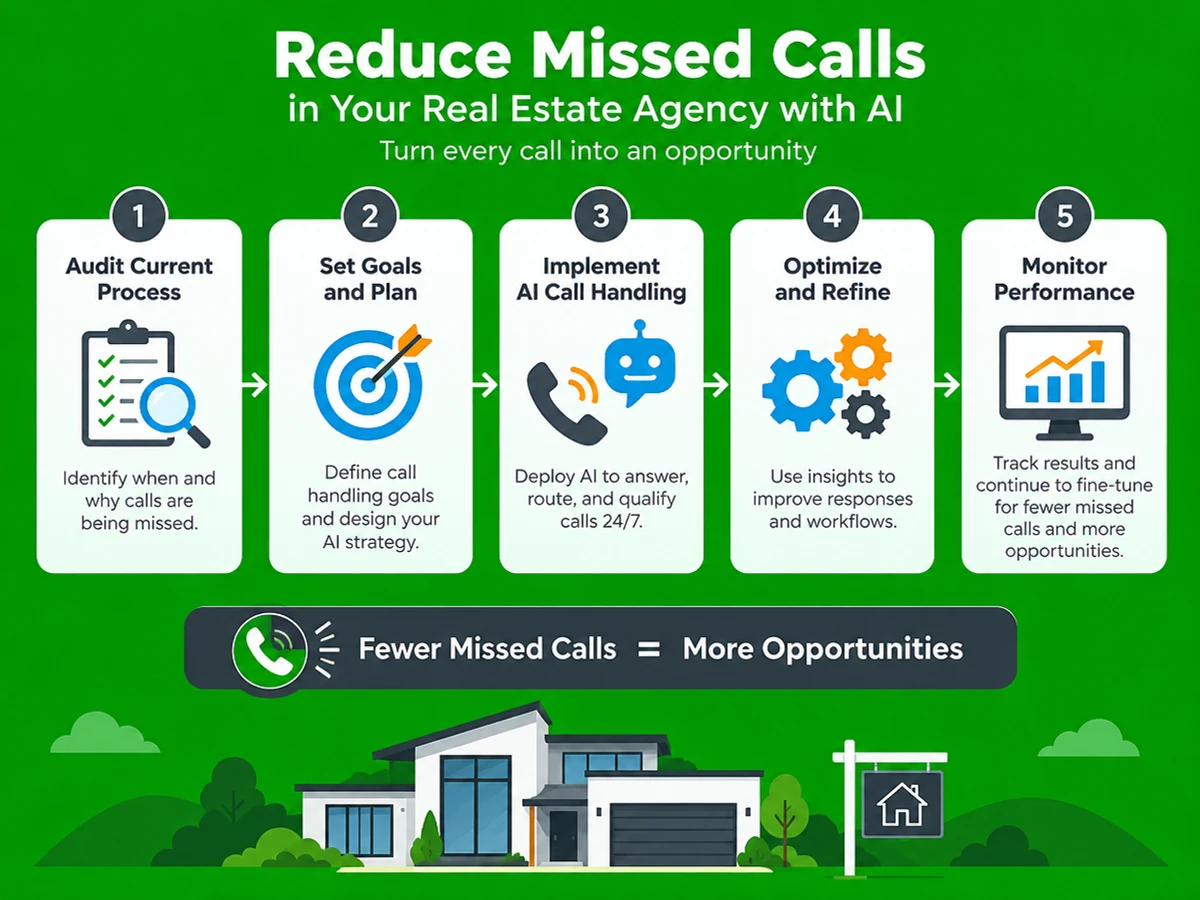
how to reduce missed calls in a real estate agency with AI | How to reduce missed calls in a real estate agency with AI, updated October 2026 by the Ezora Team. This beginner-friendly guide walks you through a 2-3 week path to full deployment.
What You'll Learn
The core fix for how to reduce missed calls in a real estate agency with AI in 2026 is an AI voice agent that answers every inbound call right away, qualifies the caller, books showings or follow-ups, and logs everything in your CRM. Agents miss calls because they're showing homes, closing deals, or off the clock. Industry data suggests agents miss 40-46% of incoming calls during peak hours. This guide gives you a step-by-step process to close that gap.
- Understand exactly what missed calls are costing your agency in lost commissions.
- Set up an AI call-answering agent without replacing your phone number or CRM.
- Automate lead qualification and follow-up so every caller gets a next step.
- Build a reporting loop that shows which calls convert and where gaps remain.
Prerequisites: a working business phone line, a CRM or spreadsheet for lead tracking, and roughly two to three weeks for setup and testing.
Why Reducing Missed Calls Matters in 2026
The phone is still the main channel for high-intent real estate inquiries, and missed calls cost more than most agencies realize. Research compiled by Zadarma shows that 62% of inbound calls to small businesses go unanswered. Of callers who don't get through, 85% never call back, and 62% of those who reach voicemail contact a competitor instead. For a real estate agency, that is a direct leak of commission income.
An analysis highlighted by PepperSend estimates that individual agents can lose over $400,000 a year to missed buyer and seller inquiries. With average commissions of $15,000 to $25,000 per deal, one missed buyer call can mean one lost transaction. Calls tend to arrive exactly when agents are tied up at showings, open houses, and closings.
Speed makes the problem worse. Data cited from NAR and LeadSimple research, via Aira, shows that 78% of sales go to the first agent who responds. Separate 2026 lead-response research from Hyperleap.ai finds that 50% of inquiries arrive after business hours. Without automated coverage, you could lose half your pipeline before a human picks up.
Key Takeaway: Missed calls cost individual agents hundreds of thousands a year. The main causes are agents being unavailable and the fact that speed to response decides who wins the deal. For supporting data, see How AI Lead Follow-Up Automation Turns Missed Calls ....
The Process at a Glance
| Step | Action | Time | Outcome |
|---|---|---|---|
| 1 | Audit current call handling and losses | 1-2 days | Clear baseline of missed-call cost |
| 2 | Deploy an AI voice agent to answer calls | 3-5 days | Every call answered in one ring |
| 3 | Automate lead qualification and follow-up | 2-3 days | Every caller gets a next step |
| 4 | Connect AI data to your CRM | 1-2 days | Centralized, searchable call records |
| 5 | Monitor and optimize monthly | Ongoing, 1 hr/week | Continuous improvement in conversion |
Total time to full deployment: about 2-3 weeks. In most cases, the AI agent is answering calls within the first week.
Step 1: Audit Your Current Call Handling and Calculate the Cost
What You're Doing
If you've ever returned from a showing to a row of voicemails, you already sense the problem. This step turns that feeling into a number leadership can act on.
How to Do It
- Pull call logs from your phone provider for the last 60-90 days and count answered versus unanswered calls.
- Estimate the average commission per closed deal and your typical lead-to-close conversion rate.
- Apply this formula: missed calls per month x conversion rate x average commission x 12 = estimated annual loss.
- Note when most calls go unanswered: after hours, during showings, over lunch, or on weekends.
Best Practices
- Separate buyer inquiries from vendor and admin calls so your estimate reflects real pipeline.
- Compare your phone system logs with your Google Business Profile call metrics for a fuller picture.
What Done Looks Like
You'll have a documented missed-call rate with a dollar figure attached, giving you a clear business case for automation.
Example
| Metric | Typical Agency Finding |
|---|---|
| Missed call rate | ~40% during business hours |
| Average commission per deal | $15,000-$25,000 |
| Estimated annual loss | $100,000+ per agent |
These numbers line up with industry-wide estimates from AnsweringAgent.com, which puts potential losses at up to $100,000 per agent each year from missed calls alone. For a more detailed walkthrough, see AI call answering services for real estate (Our top picks) - Allo.
Step 2: Deploy an AI Voice Agent to Answer Every Call Instantly
What You're Doing
This is the heart of how to reduce missed calls in a real estate agency with AI. The agent picks up on the first ring, 24/7, replacing voicemail and hold queues.
How to Do It
- Choose an AI call-answering platform for real estate, such as Ezora, that connects to your existing business number so you don't have to switch.
- Script the opening and qualifying questions: property interest, timeline, budget range, and preferred contact method.
- Set up call routing rules so urgent or high-value calls can still go live to an agent when one is free.
- Test with sample calls from buyers, sellers, renters, and vendors before going live.
Best Practices
- Keep the agent's voice and tone consistent with your brand. A stiff, generic script erodes trust fast.
- Start with after-hours and weekend coverage. Hyperleap.ai research shows about half of real estate inquiries come in outside 9-to-5, with peaks in the evenings and on weekends.
Common Mistakes
Mistake: Treating the AI agent as a voicemail replacement that only takes messages. Fix: Set it to qualify and schedule, not just record, so leads move forward without a callback delay.
What Done Looks Like
Ezora builds its tools so automation fits into existing workflows without getting in the way. Done right, every call is answered live by the AI agent on the first ring, whether it's 2 PM on a Tuesday or 9 PM on a Sunday.
Step 3: Automate Lead Qualification and Follow-Up After Every Call
What You're Doing
Answering the call is only half the job. Aira's speed-to-lead research, which cites the MIT Lead Response Management Study, found that the odds of qualifying a lead drop 21x when response time goes from 5 minutes to 30 minutes. This step ensures every qualified caller gets an immediate next action.
How to Do It
- Have the AI agent send a text confirmation or booking link as soon as the call ends.
- Build automated follow-up sequences (SMS plus email) for leads who aren't ready to book yet.
- Route hot leads, meaning people ready to view a property this week, straight to a live agent's calendar.
- Set a firm rule that no lead goes more than 24 hours without a second touchpoint.
Best Practices
- Match follow-up to intent. Buyers actively searching need same-day contact, while early-stage inquiries can take a slower drip.
What Done Looks Like
Every caller, whether or not a human was available, has a qualifying conversation and a concrete next step within minutes of hanging up.
Step 4: Connect AI Call Data to Your CRM and Reporting
What You're Doing
Once the AI is answering calls, you need visibility into what it's doing. Without it, you've just swapped one blind spot for another.
How to Do It
- Connect the AI agent to your CRM (Customer Relationship Management) system so transcripts, lead details, and booking outcomes sync automatically.
- Set up a weekly report covering calls answered, leads qualified, showings booked, and conversion rate by source.
- Tag calls by property type or listing so you can measure marketing spend against actual call volume.
What Done Looks Like
Your team can open one dashboard to see calls received, showings booked, and where follow-up is slipping, without cross-checking phone logs against spreadsheets. You end up with centralized, searchable call records.
Step 5: Monitor, Train, and Optimize the AI Agent Monthly
What You're Doing
This is ongoing maintenance. AI call handling improves with regular tuning, and your agency's needs will keep changing.
How to Do It
- Review a sample of call transcripts each month for tone, accuracy, and missed qualifying questions.
- Update scripts whenever new listing types, neighborhoods, or promotions launch.
- Track how many AI-handled calls become booked showings compared with those that needed a human to step in.
What Done Looks Like
The agent's conversion rate climbs month over month, and your team spends its review time refining scripts instead of chasing missed calls. The result is continuous improvement in conversion.
What to Do After Reducing Missed Calls
Phase 1 (Weeks 1-4): Confirm the AI agent is answering close to 100% of calls, and compare your new answer rate against the Step 1 baseline.
Phase 2 (Months 2-3): Extend coverage to SMS and web chat so the same qualification logic works on every channel.
Phase 3 (Month 4 onward): Use call data to guide marketing spend. You'll know which listings and campaigns generate calls that actually close.
Resources You'll Need
| Resource | Role | Status | Price |
|---|---|---|---|
| Ezora | AI voice agent for call answering, lead follow-up, and reporting | Required | Paid, quote-based |
| NAR Research and Statistics | Benchmark data on buyer behavior and response expectations | Recommended | Free |
| Follow Up Boss | CRM to centralize lead records and follow-up sequences | Recommended | Paid |
| Google Business Profile | Tracks call metrics from local search listings | Optional | Free |
| CallRail | Call tracking and attribution for marketing campaigns | Optional | Paid |
See also, see Best AI Tools for Real Estate Agents, Ranked for 2026.
Troubleshooting Common Issues
Calls are being answered, but qualified leads still aren't turning into showings
Likely cause: The qualifying script is too generic, or the handoff to a live agent is slow. Fix: Tighten the script to capture timeline and budget, and send hot leads directly to an agent's calendar in real time.
Agents are skeptical and keep picking up calls manually, bypassing the AI
Likely cause: They don't trust the call quality, or they worry about losing the personal touch. Fix: Share transcripts and conversion data weekly so agents see the AI as a filter that hands them warmer leads.
After-hours calls are answered, but follow-up stalls until the next business day
Likely cause: Follow-up sequences aren't connected to the AI agent's output. Fix: Trigger the first follow-up text or email automatically right after the call, rather than waiting for a manual morning review.
Call volume spikes during a new listing launch and response quality drops
Likely cause: The agent's script wasn't updated with the new property's details. Fix: Build a pre-launch checklist that updates scripts and FAQs before every new listing goes live. For more troubleshooting advice, see What You're Getting Wrong About AI-and How to Fix It.
Conclusion
Learning how to reduce missed calls in a real estate agency with AI comes down to five repeatable steps: audit your losses, deploy an agent that answers every call, automate qualification and follow-up, connect the data to your CRM, and optimize monthly. Ezora helps businesses stop missing calls and leads with fast, integrated AI voice and messaging agents. Your team doesn't need retraining, and most deployments are running in about two weeks.
Key Takeaways
- Answering on the first ring protects commission revenue, since 78% of sales go to the first agent who responds.
- Automation pays off when it qualifies and follows up, not just when it answers. Speed without a next step still loses leads.
- Your next move: run the Step 1 audit this week, then use the number to justify an AI call-answering system before your next busy season.
FAQ
How to reduce missed calls in a real estate agency with AI (2026)?
Deploy an AI voice agent that answers every inbound call in real time. The agent qualifies callers by timeline and budget, books showings automatically, and syncs interaction data to your CRM. Pair it with automated follow-up sequences to close the gap that opens when agents are out showing homes or off the clock. Platforms like Ezora can usually have this running in about two weeks.
How many calls do real estate agencies typically miss?
Research on real estate call handling from Aira finds agents miss 40-46% of incoming calls. Half of leads arrive after hours, so without automated coverage, a large share of inquiries never reach a live person.
What does an AI call answering system cost for a small agency?
Pricing depends on the provider and your call volume. Most AI voice agent platforms for real estate are quote-based, depending on lines, call volume, and integrations. Request a tailored quote from a provider like Ezora for an accurate figure.
Will an AI agent replace my receptionist or agents?
No. It captures calls that would otherwise go to voicemail, qualifies the caller, and hands warm, ready-to-book prospects to your human agents. Relationship-building stays with your team.
How quickly can I see results after deploying AI call answering?
Most agencies get their answer rate close to 100% within the first week. Improvements in showing bookings and follow-up consistency usually appear within the first month.
Does AI call answering work for after-hours and weekend calls?
Yes, and it's one of the strongest use cases. Lead response data from Hyperleap.ai shows roughly half of real estate inquiries arrive outside 9-to-5, peaking in the evenings and on weekends, when agencies are least staffed.
What's the single biggest factor in converting a real estate lead?
Response speed. Research from NAR and LeadSimple, cited by Aira, shows 78% of sales go to the first agent who responds. That's why instant AI call answering can move conversion more than almost any other operational change.
Can AI call answering integrate with my existing CRM and phone number?
Most modern AI voice agent platforms, Ezora included, connect to your existing business number and CRM rather than requiring you to switch systems, keeping disruption to your team minimal.
Methodology: This guide draws on publicly available 2025-2026 industry research on missed call rates, real estate lead response statistics, and AI call automation practices, combined with established real estate lead-conversion frameworks. Figures reflect aggregated industry data and may vary by market, agency size, and call volume. Agencies should run their own audit (Step 1) to calculate figures specific to their business.