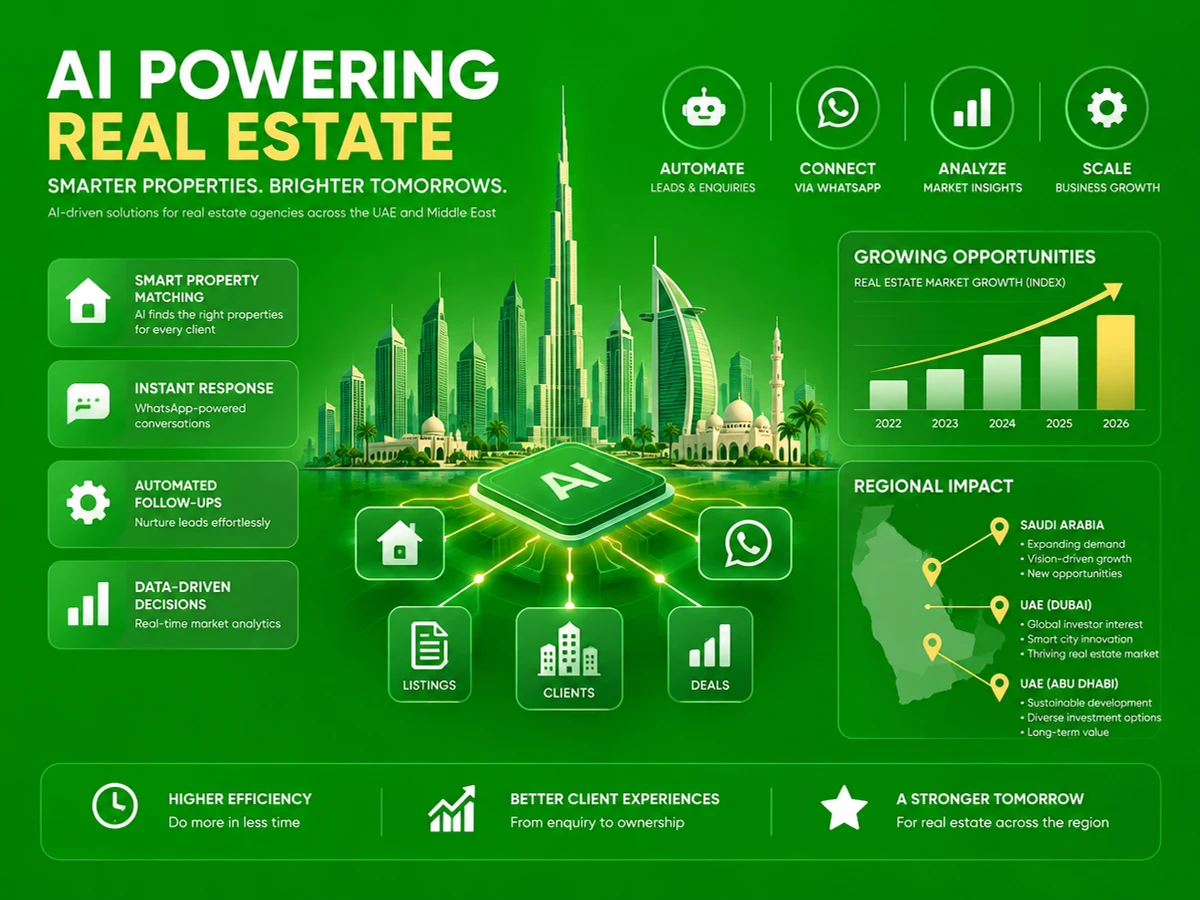
AI for real estate agencies in the UAE and Middle East | AI for real estate agencies in the UAE and Middle East in 2026 means putting always-on voice and messaging agents, WhatsApp-first automation, and predictive analytics to work. These tools capture leads, qualify buyers, and schedule viewings the moment an inquiry arrives, so prospects no longer wait hours or days for a reply. The region's property sector is adopting AI quickly. 189 PropTech companies, which are technology firms focused on real estate, are now active in the UAE, nearly triple the number from two years earlier. Dubai alone processed AED 761 billion in real estate transactions in 2024. For agencies across the Gulf, the question is no longer whether to adopt AI, but how quickly they can close the gap between a prospect's first message and a human reply.
In a market where 78% of buyers work with the first agent who responds, and most inquiries now arrive on WhatsApp in Arabic, English, or both, speed and language coverage matter more than listing inventory.
What Does AI for Real Estate Agencies in the UAE and Middle East Actually Mean in 2026?
AI for real estate agencies in the UAE and Middle East refers to a full stack of customer-facing and back-office tools: conversational agents for calls and chats, predictive pricing models, and automated lead routing, all built around the region's WhatsApp-and-portal lead flow. It is a layered system that touches marketing, sales, and property management at once.
Policy Environment Accelerating AI Adoption
- Data Backbone for Valuations: The Dubai Land Department's (DLD) Mo'asher price index gives brokers, lenders, and portals a reliable data backbone for smarter property valuations.
- PropTech Hub Initiative: The DLD's broader PropTech Hub initiative is designed to attract 200 startups and over $300 million in investment into real estate technology.
Three Layers of Adoption
- Customer-facing agents: Voice and chat systems that answer calls, respond to WhatsApp inquiries, and qualify leads around the clock without adding headcount.
- Predictive and pricing intelligence: Tools that analyze behavioural signals, viewing patterns, and content engagement to estimate purchase probability before a buyer submits an inquiry.
- Agentic operations: Systems that go beyond chatbots to handle qualifying leasing leads, arranging viewings, and forecasting rental yields with minimal human input.
McKinsey-sourced estimates, cited in regional PropTech coverage, suggest that generative AI could generate $110 billion to $180 billion in value for the real estate industry, with broader AI applications adding further upside. For a mid-sized Dubai or Abu Dhabi agency, the practical question is simpler: who answers the phone at 9pm when a serious buyer calls about a listing in JVC or Business Bay?
Key Takeaway: Regulatory data infrastructure (DLD, RERA) and lead-volume pressure are pulling AI adoption forward, making 2026 a year for practical implementation rather than experimentation. For deeper context, see AI and the Future of Real Estate in the UAE.
Why Is WhatsApp the Center of AI Real Estate Solutions in the UAE?
WhatsApp dominates property inquiries because it is where buyers already spend their time, and where major portals send their call-to-action buttons. In Dubai, 60 to 80% of property seekers initiate their first enquiry through WhatsApp. Regional reporting puts active WhatsApp users in the UAE at roughly 5.66 million, with message open rates around 98%, far above the 22% typical for email.
The Scale of the Channel
| Metric | Figure | Why It Matters |
|---|---|---|
| Daily WhatsApp usage among UAE residents | Over 90% | Agencies that aren't WhatsApp-first miss the default channel entirely |
| Message open rate on WhatsApp vs. email | 98% vs. 22% | Only a fraction of marketing emails actually get read |
| Deal close rate, WhatsApp-first agents | 4.7x higher | Per-lead conversion advantage over cold calls and portal forms alone |
| Qualified leads per project launch | 2-3 of ~30 inquiries | Volume isn't the bottleneck, qualification and nurture are |
Figures compiled from regional WhatsApp marketing data for Dubai real estate.
A Regulatory Wrinkle Agencies Must Respect
The Real Estate Regulatory Agency (RERA), which oversees the sector, restricts outbound bulk messaging, calls, and unsolicited WhatsApp contact to protect investor privacy. Violators face fines and possible registration suspension. That makes inbound-first automation, which instantly answers the person who reached out, far more valuable than outbound broadcast tools, since bulk messages and broadcasts are now off-limits for UAE real estate professionals.
This is where Ezora fits the market. Its WhatsApp agent holds natural conversations in Arabic and English and replies the moment a lead opts in. It does not push unsolicited outreach, so agencies stay compliant while catching every inbound inquiry.
Key Takeaway: In the UAE, AI real estate solutions succeed by handling inbound WhatsApp volume in multiple languages within regulatory limits, not by broadcasting aggressively. For deeper context, see How AI Is Helping Real Estate Companies in United Arab ....
What Core AI Workflows Do Property Agencies Need in 2026?
Real estate automation in the Middle East centers on four repeatable workflows: instant lead response, bilingual qualification, viewing coordination, and post-viewing follow-up. Agencies that automate these stages consistently outperform those relying on manual call-backs, because speed to first contact is the strongest single predictor of conversion in property sales.
The Cost of Slow Response
- Average Response Time: Industry-wide, the average real estate agent takes 917 minutes, or over 15 hours, to respond to a new lead inquiry.
- First Responder Advantage: A significant 78% of buyers choose the first agent who responds to their inquiry.
- Qualification Likelihood: Agents who respond within five minutes are 21 times more likely to qualify that lead than those who wait 30 minutes.
- Delayed Follow-up: Research reviewing over 55 million sales activities found that 57.1% of first call attempts occur after more than a week has passed since the initial inquiry.
- Instant lead capture: AI voice and chat agents answer every call or WhatsApp message within seconds, closing the window in which competitors can poach the lead.
- Bilingual qualification: Agents trained in Arabic and English screen budget, timeline, and preferences before handing a warm lead to a human.
- Viewing scheduling: Automated booking removes the back-and-forth of matching slots across WhatsApp threads and calendars.
- Post-viewing nurture: Follow-up sequences keep leads engaged until they are ready to transact, which matters because only 2 to 3 of roughly 30 inquiries per launch are genuinely qualified.
- Real-time reporting: Dashboards show which listings, channels, and agents are converting, replacing spreadsheet tracking.
Agents responding within 60 seconds convert leads to appointments at roughly 28%, against an industry average closer to 8%, according to callback speed analysis of 2026 real estate inquiry data.
This is the gap Ezora is built to close. Its AI agents answer every call, follow up on every lead, and generate real-time reports, tuned to an agency's existing listings and processes. Staff don't have to learn new software to use them.
Key Takeaway: The highest-leverage AI workflow isn't a flashy feature. It is closing the response-time gap between an inquiry and first human contact, because that single metric drives most lost commission. For deeper context, see Real Estate Automation: What Actually Works in 2026.
How Does Real Estate Automation Vary Across Dubai, Abu Dhabi, and Saudi Arabia?
Real estate automation is most mature in Dubai, but it is scaling quickly across Abu Dhabi, Riyadh, and the wider GCC as governments fund PropTech infrastructure. Each market has its own regulators, yet core use cases, including lead response, bilingual support, and predictive pricing, hold steady across borders.
Regional Snapshot
| Market | Key Driver | Notable Data Point | Regulatory Anchor |
|---|---|---|---|
| Dubai / UAE | PropTech Hub, WhatsApp-first leads | 40-50% of MENA PropTech startups based in Dubai, over $500M cumulative investment | Dubai Land Department (DLD), RERA |
| Abu Dhabi | Smart building and commercial AI | AI-enabled office buildings seeing occupancy rates up to 12% higher than legacy stock | Department of Municipalities and Transport |
| Saudi Arabia | Vision 2030, giga-projects | PropTech market valued at $860 million in 2024, forecast to reach $2.48 billion by 2030 | Real Estate General Authority (REGA) |
| Broader GCC | AI construction and valuation | AI in GCC construction forecast to add $100 billion annually to regional GDP by 2030 | Varies by jurisdiction |
What This Means for Multi-Market Agencies
- Portfolio agencies: Firms operating across the UAE, Saudi Arabia, and Qatar need AI agents that switch languages and compliance rules by jurisdiction, without a separate system for each office.
- Developer-aligned brokerages: Agencies selling off-plan giga-project inventory benefit from automated qualification that filters serious buyers from the speculative inquiries typical during launches.
- Rental management companies: Firms handling recurring tenant communication across emirates see the clearest ROI, since renewal and maintenance queries are repetitive and well suited to AI.
Key Takeaway: Dubai remains the proving ground, but Saudi Arabia's Vision 2030 spending and Abu Dhabi's commercial AI adoption mean regional operators need platforms that can serve several markets from one system. For deeper context, see Dubai's Real Estate Market in 2024: How the Rise of AI and ....
How Should Agencies Implement AI Without Disrupting Existing Teams?
The agencies that succeed prioritize integration over replacement. They choose systems that slot into existing WhatsApp numbers, phone lines, and CRMs instead of forcing staff to learn new software. Those that struggle usually bolt on a generic chatbot never aligned with how leads actually arrive and convert in their market.
Implementation Checklist
- Audit your lead channels first: Map how many inquiries arrive via WhatsApp, phone, and portal forms before picking a tool, since that mix determines which channels need automation most urgently.
- Prioritize bilingual coverage: Arabic and English handling is non-negotiable in a market where buyers span GCC nationals, expatriates, and international investors.
- Demand real-time reporting: Choose a system that shows which listings and agents are converting, not just a transcript log.
- Protect compliance: Favor inbound-response automation over outbound broadcast tools, given RERA's restrictions on unsolicited contact.
- Set a realistic timeline: A well-scoped rollout should take weeks, not months, so the project doesn't lose momentum.
Ezora is built around this philosophy: customer-facing businesses deserve automation that works quietly inside their existing workflows. Its AI voice and messaging agents are designed to go live in about two weeks, with no staff retraining, which matters for agencies that cannot afford a months-long migration during a busy transaction year.
Common Pitfalls
| Pitfall | Consequence | Better Approach |
|---|---|---|
| Deploying English-only bots | Loses Arabic-speaking and GCC-national leads | Select agents trained in both languages from day one |
| Using AI for outbound blasts | Risks RERA fines and reputational damage | Focus automation on inbound response and follow-up |
| No reporting layer | Agency can't tell which channel or listing drives revenue | Require real-time dashboards as a baseline feature |
| Long, disruptive rollouts | Staff resistance, stalled adoption | Choose platforms that integrate with existing numbers and CRMs |
Key Takeaway: The agencies getting the most from AI treat it as an invisible layer on existing workflows. It answers the calls and WhatsApp messages the business already receives, rather than adding a separate system employees must learn.
Conclusion
AI for real estate agencies in the UAE and Middle East in 2026 is no longer an experiment. It is the baseline for buyers who send a WhatsApp message and expect a reply within minutes. The agencies capturing the largest share of leads pair bilingual, inbound-first automation with real-time reporting, all within a regulatory landscape shaped by the DLD, RERA, and REGA.
- Speed decides deals: With the average agent taking over 15 hours to respond and 78% of buyers choosing the first responder, instant AI response is the highest-leverage change an agency can make.
- WhatsApp is the primary channel: Over 90% of UAE residents use WhatsApp daily, and most property inquiries start there, in Arabic or English.
- Compliance shapes strategy: RERA's restriction on outbound bulk messaging makes inbound automation, not broadcast marketing, the sustainable path.
- Regional scale is growing: Saudi Arabia's PropTech market and Dubai's PropTech Hub point to sustained, government-backed investment through 2030.
- Integration beats disruption: Tools that work within existing phone numbers and WhatsApp accounts see faster adoption than standalone platforms requiring retraining.
Agencies weighing next steps can start by looking at how Ezora builds WhatsApp-first, bilingual AI agents that answer every call, follow up on every lead, and report results in real time, typically going live within two weeks.
FAQ
What is AI for Real Estate Agencies in the UAE and Middle East in 2026?
AI for real estate agencies in the UAE and Middle East in 2026 refers to the combined use of AI voice agents, WhatsApp-based conversational automation, and predictive analytics. These solutions help agencies capture leads instantly, qualify buyers in both Arabic and English, and manage listings data across Dubai, Abu Dhabi, and Saudi Arabia. The approach has moved beyond experimental chatbots into agentic systems that handle leasing qualification, viewing scheduling, and rental yield forecasting with minimal manual input.
Why is WhatsApp so important for AI real estate solutions in the UAE?
WhatsApp is the default inquiry channel because major portals route their call-to-action buttons there, and 60 to 80% of property seekers initiate their first enquiry through the platform. An AI agent that cannot operate fluently on WhatsApp in both Arabic and English will miss most inbound demand.
Is it legal to use AI to message real estate leads in the UAE?
Responding to leads who contact you first is standard practice. RERA, however, has restricted unsolicited outbound marketing calls, texts, and WhatsApp messages, and violations carry fines. Agencies should use AI mainly for inbound response and opt-in follow-up, not cold broadcasting.
How much does AI automation save a real estate agency in lost leads?
Industry research shows agents who respond within five minutes are 21 times more likely to qualify a lead than those who wait 30 minutes. Missed-lead costs have been estimated at roughly $7,500 per lost lead in some markets. Since average response times often stretch into hours, automating the first response is usually the highest-return change an agency can make.
Which markets in the Middle East are leading in real estate AI adoption?
Dubai leads, with 40-50% of all PropTech startups in the MENA region. Saudi Arabia's PropTech market is forecast to grow from $860 million in 2024 to $2.48 billion by 2030 under Vision 2030. Abu Dhabi is also making meaningful progress in commercial and smart-building AI.
Do agencies need to replace their CRM to use AI agents?
No. The most effective setups connect AI voice and WhatsApp agents to existing phone numbers, listing portals, and CRM systems rather than replacing them. This is why platforms like Ezora are built to go live without staff retraining.
How long does it take to implement AI for a real estate agency?
Well-scoped deployments focused on a single workflow, such as WhatsApp lead response, can be live in weeks rather than months. Ezora, for example, is designed to get customer-facing AI agents running in about two weeks.
What languages should an AI real estate agent in the UAE support?
At minimum, an AI real estate agent in the UAE should support Arabic and English. Buyers in Dubai and Abu Dhabi include GCC nationals, long-term expatriates, and international investors, and they often switch between languages within the same conversation.
This article synthesizes publicly available market research, regulatory guidance, and industry reporting on AI adoption in UAE and Middle East real estate as of October 2026. Figures cited reflect third-party research and may vary by source methodology. Agencies should verify current RERA, DLD, and REGA requirements directly with those authorities before implementing outbound messaging strategies.