Ezora logo
Ezora
Blog
Book a call
Ezora
© Ezora 2026. All rights reserved.
< All posts

AI calling agent in Tamil, Hindi and Telugu for real estate in 2026

Discover how the AI calling agent in Tamil, Hindi, and Telugu will revolutionize real estate communication in India by 2026.

·Updated November 18, 2026·13 min read
AI calling agent in Tamil, Hindi and Telugu for real estate in 2026

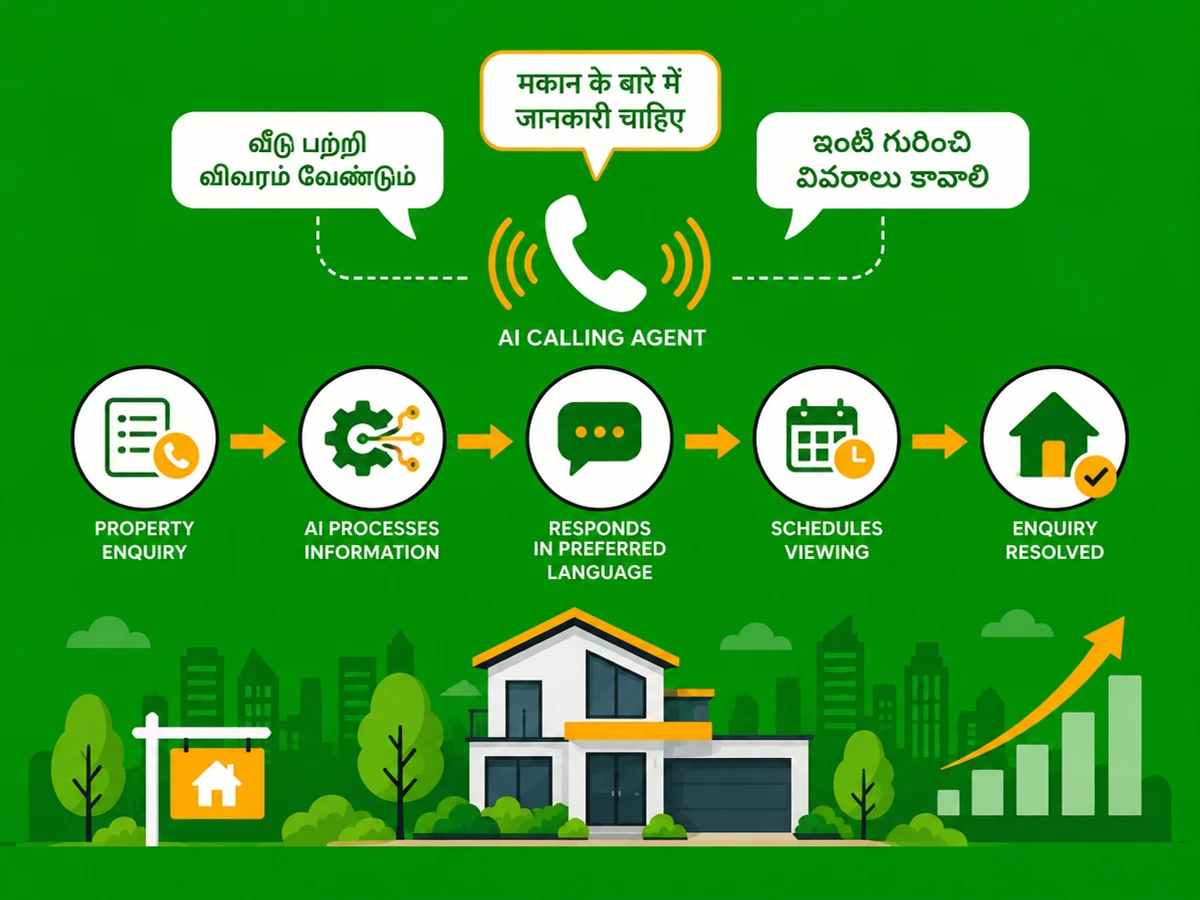
AI calling agent in Tamil | An AI calling agent in Tamil, Hindi and Telugu for real estate in 2026 is a voice-based software agent that answers or places property calls and speaks with callers naturally in their preferred Indian language. It qualifies enquiries, shares project details, and books site visits without a human agent on the line. For developers and brokers in Chennai, Hyderabad, Bangalore, and the wider Hindi belt, this matters because most property callers would rather speak their own language than English. An AI calling agent in Tamil, built for real estate, can answer every call instantly in whichever of the three languages the caller picks.

In Indian real estate, the language a lead calls in is often a stronger buying signal than the channel they called from, yet most CRMs and call centers are still built around a single language assumption.

What is an AI calling agent in Tamil, Hindi and Telugu for real estate in 2026?

This is a conversational voice system. It listens to a caller, understands what they want in their own language, and replies with natural speech in real time. Older interactive voice response (IVR) menus force callers through pre-recorded options. These agents hold an actual back-and-forth conversation and can switch language mid-call if the caller does. By 2026, the category has moved past pilot projects and is standard infrastructure for high-volume property enquiry lines across South India and the Hindi-speaking north.

Core components of the system

  • Speech recognition tuned to Indian accents: The agent transcribes spoken Tamil, Hindi, or Telugu, including regional accents and code-mixed phrases like Hinglish.
  • Conversational reasoning: The agent decides what to say next based on answers about budget, locality, or configuration (2BHK, 3BHK, villa plot).
  • Natural-sounding voice output: Responses match the language and tone the caller used, so the exchange feels human.
  • Workflow actions: The agent checks calendar availability, logs enquiries into a CRM, sends WhatsApp confirmations, or routes hot leads to a human closer.

This technology differs sharply from a simple chatbot or a basic IVR tree, which both tend to fall apart once a caller steps off the scripted path. If you have ever been stuck in a phone menu asking you to "press 2 for pricing," you already know the difference.

Key Takeaway: An AI calling agent in Tamil, Hindi and Telugu for real estate is not a translation layer bolted onto an English system. It is built from the ground up to converse naturally in whichever language the caller chooses. For deeper context, see AI Calling for Real Estate Agents | AI IntelliCall.


Why does language matter for real estate enquiries in India?

Property buying is an emotionally loaded, high-value decision. Buyers convert better when they don't have to explain their budget, loan status, or family needs in a second language. India's linguistic map makes this a scale problem for any agency selling across more than one state.

The scale of the language question

According to the 2011 Census of India, hundreds of millions of potential buyers use Tamil, Hindi, or Telugu as their primary language of daily conversation. These are the same buyers calling about 2BHK flats, plotted developments, and gated villa projects.

  • Hindi speakers: 52.83 crore speakers, the most spoken language in the country.
  • Telugu speakers: 8.11 crore speakers.
  • Tamil speakers: 6.90 crore speakers, representing 5.70 percent of the total population.

What happens when language or speed fails

  • Cold leads from slow response: 70-80% of real estate leads in India go cold due to delayed or missed responses, according to a 2026 analysis of Indian developer lead data.
  • Enquiries never answered: Across 34,148 property enquiries at 14 Indian brokerages studied by ClosingFox in 2026, only 42% ever reached a connected phone call. That means 58 of every 100 enquiries were never spoken to, and the median first-call time was 15.8 hours.
  • Lost momentum from slow first contact: Leads contacted within five minutes convert at 8 to 10 times the rate of leads contacted after 30 minutes, while the average first response time for Indian portal leads is 4 to 6 hours, as documented by Realatic's 2026 conversion benchmarks.

Key Takeaway: A caller greeted in their own language and answered within seconds, not hours, is far less likely to call a competing builder. A multilingual AI agent closes the language gap and the speed gap in a single call. For deeper context, see Voice AI Language Adoption in India.


Missing calls after hours?

Book a 20-minute call. We'll show you where leads slip through and what an AI front office would answer, book and follow up for you.

Book a call

How does an AI voice assistant for property enquiries handle a call end to end?

An AI voice assistant for property enquiries follows the same sequence each time: it starts when a lead form is submitted or a call comes in, moves through qualification, and ends with a booked site visit or a handoff to a human. The real advantage is how fast and how consistently it runs that sequence, in whatever language the lead prefers.

The typical enquiry-to-visit flow

StageWhat happensLanguage handlingTypical outcome
Lead capturePortal form, missed call, or inbound ring is detected instantlyLanguage preference inferred from listing region or caller's first wordsCall initiated within seconds, not hours
Greeting and intent checkAgent introduces the project and asks what the caller is looking forOpens in Tamil, Hindi, or Telugu; switches if caller responds in another languageCaller feels understood immediately
QualificationBudget, configuration, locality, timeline, and loan status are askedFollow-up questions stay in the caller's chosen languageLead scored as hot, warm, or cold
SchedulingA site visit slot is offered and confirmed against live calendar availabilityConfirmation repeated back in the same languageVisit booked, WhatsApp reminder sent
Handoff or follow-upHot leads routed to a human closer; others queued for automated follow-upCall summary and transcript logged for the sales teamNo enquiry sits unattended

Why this matters operationally

Internal benchmarking across 47 real estate projects in India, cited by Mores' 2026 PropTech review, found that pre-sales calling time fell by 94%, and verified site-visit bookings rose by 312% after AI qualification systems were introduced. Kraya's client data points the same way. Teams that moved from multi-hour response windows to automated responses under five minutes saw a 3 to 4 times increase in lead-to-conversation rate and a 2 to 3 times increase in site visit scheduling, according to a report by Kraya.

"In our first six months using automation, we cut average lead response time from 3.5 hours to under 2 minutes. Conversion from enquiry to site visit jumped from 11% to 34%." A real estate broker in Pune, quoted in Kraya's 2026 sales-call analysis

Key Takeaway: The lift comes from speed and language match working together, not from either one alone. Before committing to a platform, agencies need to check a few practical and regulatory boxes. For deeper context, see AI Voice Call Agents for Business Automation.


What should real estate agencies evaluate before adopting AI automation in Indian real estate?

Agencies should weigh language coverage, compliance readiness, integration effort, and reporting depth before choosing a platform. Getting this wrong usually means callers routed to the wrong language, consent and calling-rule violations, or a system nobody on the sales floor uses.

Regulatory and compliance context

Indian real estate outreach in 2026 operates under a tightening compliance environment. Any build needs to clear several key regulations:

  • RERA section 11: Sets out agent and project disclosure obligations. RERA authorities had been established across 35 states and union territories as of 2025, as reported by Ken Research's PropTech market study.
  • TRAI 140xx calling rules: Govern telemarketing and unsolicited commercial communications.
  • DPDP (Digital Personal Data Protection Act): Sets standards for data privacy and consent, according to a 2026 review of real estate app compliance requirements.

Evaluation criteria

  • Language depth, not just a logo: Confirm the agent can hold a sustained conversation in Tamil, Hindi, and Telugu, including regional accent variation. A translated greeting that falls back to English is not enough.
  • Consent and calling-rule alignment: The platform should support TRAI-registered sender norms and DPDP-consistent consent logging.
  • CRM and calendar integration: Qualified leads and booked visits should flow directly into the tools your sales team already uses, not a parallel dashboard.
  • Reporting sales managers can act on: Look for real-time visibility into call volume, qualification outcomes, and no-show rates by project and by language.
  • Time to go live: A platform that takes months to configure wipes out its own speed advantage. A working deployment within weeks is the realistic target.

Key Takeaway: Leading agencies treat language coverage and compliance as table stakes, then separate themselves on how fast the system goes live and how usable the reporting is for non-technical sales teams. For deeper context, see AI Automation for Estate Agentsand Realtors 2026 - Aiotagen.


How Ezora delivers a multilingual AI calling agent for real estate teams

Ezora is built for customer-facing businesses in India, including real estate agencies, rental management companies, and home services firms. These businesses cannot afford to lose a lead because nobody picked up in the right language. Ezora's voice agents speak Tamil, Hindi, Telugu, and English, so a caller in Chennai, Hyderabad, or Delhi is answered in the language they are most comfortable using.

What Ezora's agents actually do on a call

  • Answer every call: Agents pick up property enquiries around the clock. A Sunday-night form submission gets engaged immediately instead of waiting for the next business morning.
  • Follow up on every lead: Scheduled follow-ups reduce enquiries that quietly go cold after one missed attempt.
  • Generate real-time reports: Sales managers see call outcomes, qualification status, and visit bookings as they happen, without a weekly manual rollup.
  • Work inside existing workflows: Agents fit the tools a team already uses, so staff have no new software to learn and no retraining cycle.

Why Indian-language fit is the core design decision

Most enquiry callers for projects in Chennai, Bangalore, and Hyderabad prefer their own language. A voice agent that defaults to English, or stumbles through a stiff translation, loses trust within the first ten seconds of the call. Ezora builds Tamil, Hindi, Telugu, and English handling into the core of the product rather than adding it later, so every caller feels they are speaking with someone from their own market.

Ezora believes customer-facing businesses deserve automation that works invisibly inside the workflows they already run, not a new system layered on top that the sales team has to be retrained on.

Key Takeaway: For an agency weighing an AI calling agent in Tamil against a larger, harder-to-staff multilingual call center, the practical difference comes down to implementation time. Ezora is designed to be up and running in about two weeks, with reporting and lead follow-up built in from day one.


Conclusion

An AI calling agent in Tamil, Hindi and Telugu for real estate in 2026 addresses the two biggest reasons Indian property leads go cold: slow response and language mismatch. Agencies that fix both at once see noticeably higher site-visit conversion from the same lead volume.

  • Speed is non-negotiable: Leads contacted within five minutes convert at several times the rate of leads contacted hours later, and most Indian portal leads still wait 4 to 6 hours for a first response.
  • Language is not optional in the south and the Hindi belt: With tens of crores of native Tamil, Hindi, and Telugu speakers, a single-language call operation caps conversion in multilingual markets.
  • Compliance is part of the build: RERA disclosure, TRAI calling rules, and DPDP consent requirements all apply to automated calling in 2026.
  • Integration beats a parallel system: The platforms that get adopted slot into existing CRM and sales workflows.
  • Ezora is built for this problem: Voice agents that answer every call, follow up on every lead, and report in real time, in Tamil, Hindi, Telugu, and English.

Agencies ready to stop losing enquiries to slow, single-language call handling can explore Ezora to see how a multilingual AI calling agent fits into an existing sales workflow within weeks.


FAQ

What is an AI calling agent in Tamil, Hindi and Telugu for real estate in 2026?

It is a voice-based AI system that answers or makes real estate enquiry calls. It converses naturally in Tamil, Hindi, or Telugu, qualifying leads, answering project questions, and booking site visits without a human for every interaction. By 2026 it is standard infrastructure for developers and brokers in multilingual markets like Chennai, Bangalore, and Hyderabad.

Can AI voice agents actually hold a real conversation in Tamil and Telugu, or just play recordings?

Modern AI voice assistants for property enquiries hold genuine back-and-forth conversations rather than playing fixed recordings. They follow up on answers and switch language mid-call if the caller does. Platforms built for Indian languages train on real conversational data rather than generic translations, which lets them handle regional accents and mixed-language speech.

How fast does a real estate lead need to be called back in India?

Research points to a five-minute window as the benchmark for strong conversion. Leads contacted within 5 minutes convert at 8 to 10 times the rate of leads contacted after 30 minutes. Yet the average Indian portal lead waits 4 to 6 hours for a first response, which is the gap an AI calling agent is designed to close.

Does an AI calling agent replace human sales agents in real estate?

No. It handles first response, qualification, and scheduling, then passes qualified, high-intent leads to a human closer for the site visit and negotiation. This frees human agents to focus on in-person conversion rather than initial dialing.

Is AI calling compliant with Indian telecom and data rules like TRAI and DPDP?

Compliance depends on how the platform is designed. A properly built 2026 real estate calling system should align with RERA section 11, TRAI 140xx calling rules, and DPDP consent requirements. Agencies should confirm these specifics with any vendor before deployment.

Which Indian language should a real estate AI agent prioritize first?

Priority should follow the project's location and buyer base: Tamil for Chennai-area projects, Telugu for Hyderabad and Andhra Pradesh markets, and Hindi for North and Central Indian buyers. English should stay available for NRI and cross-city enquiries. Multi-city agencies usually need all four languages handled by one agent rather than separate language lines.

How long does it take to deploy a multilingual AI calling agent for a real estate business?

Timelines vary with platform choice and CRM complexity, but a well-designed system should not need months of setup. Ezora, for example, is designed to go live in about two weeks without requiring staff to learn new software.

What results can a real estate agency expect from adopting an AI calling agent?

Documented India benchmarks suggest first-response times can fall from hours to under a minute and site-visit bookings can rise meaningfully. One 2025-26 benchmark across 47 Indian projects found site-visit bookings increased by 312% due to AI qualification systems. Actual results depend on lead volume, language mix, and how well the agent fits the existing sales process.


This article synthesizes publicly available 2025-2026 India real estate, PropTech, and lead-conversion research cited inline. Language speaker figures are drawn from the 2011 Census of India as reported by secondary sources. Verify current TRAI and DPDP requirements with official sources before deployment, as rules may be updated.

Read next

  • 10 Best AI Voice Agents for Real Estate Developers in India 2026Discover the best AI voice agents for real estate developers in India in 2026, enhancing customer engagement and streamlining operations for your business.
  • AI Voice Agent vs Telecalling Team: Which Is Best for Indian Real Estate Builders in 2026?Discover the pros and cons of AI voice agent vs telecalling team for Indian real estate builders to make an informed decision for 2026.
  • 10 Best AI Voice Agents for Real Estate Lead Qualification in 2026Discover the best AI voice agents for real estate lead qualification 2026 that can streamline your processes and enhance client engagement effectively.

Missing calls after hours?

Book a 20-minute call. We'll show you where leads slip through and what an AI front office would answer, book and follow up for you.

Book a call
Social Share
Add as a preferred source on Google
Social Share
Add as a preferred source on Google
Ezora logoEzora

Every call answered. Every lead followed up.

Book a 20-minute call to see what Ezora's AI agents can do for you.

Book a callVisit ezora.co